Asst Professor Rush University Medical Center Chicago, Illinois, United States
Purpose: Pulmonary embolism (PE) is a multifactorial disease posing great risk for short- and long-term morbidity and mortality. Published data on risk stratification, utilization of PE Response Teams (PERTs), and treatment outcomes are highly variable and unknown. This single academic center review describes a unique radiology-initiated PERT and demonstrates the ability to calculate PE incidence and risk stratification, allowing for long-term follow-up and quality outcome evaluation.
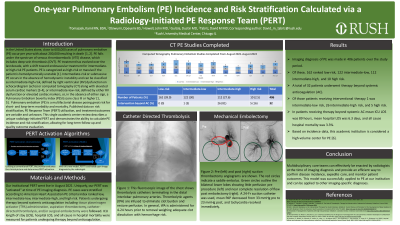
Methods/Materials: Our institutional PERT went live in August of 2021 and was activated at the time of PE imaging diagnosis. PE cases were stratified according to American Heart Association PE criteria scoring index ranked low, intermediate-low, intermediate-high, and high risk. Patients undergoing therapy beyond systemic anticoagulation including systemic tissue plasminogen activator (TPA), suction thrombectomy, surgical embolectomy, and/or catheter directed thrombolysis were followed. ICU length of stay (LOS), hospital LOS, and all cause in hospital mortality were measured for patients undergoing therapy beyond anticoagulation.
Results: Imaging diagnosis of PE was made in 343 patients over the study period. Of these, 132 ranked low-risk, 105 intermediate-low, 97 intermediate-high, and 9 high risk. A total of 30 patients underwent therapy beyond systemic anticoagulation. Of those patients receiving interventional therapy 1 was intermediate-low risk, 24 intermediate-high risk, and 5 high risk. In patients receiving therapy beyond systemic anticoagulation mean ICU LOS was 89 hours, mean hospital LOS was 6.3 days, and all cause hospital mortality was 3.3%.
Conclusions: Multidisciplinary care teams can effectively be enacted by radiologists at the time of imaging diagnosis and provide an efficient way to confirm disease incidence, expedite care, and monitor patient outcomes. This model was successfully applied to PE at our institution and can be applied to other imaging-specific diagnoses.