Integrated IR Resident Cleveland Clinic Foundation, United States
Purpose: With the recent inclusion of the Supplemental Application, the Integrated Interventional Radiology (IR) match process has become more complex. In this application, geographical preference signals can be noted by applicants. The aim of this study is to assess the relationship between signaling a geographic area and interviews received from that region.
Methods/Materials: Geographic preference, program names, and interview status data of applications (n=9776) were gathered from the Texas STAR database. Each program was identified as one of nine regions outlined in the ERAS Supplemental Application (Table 1). Only applications for a geographic preference listed were included. Applications were stratified according to regions with a connection, and interview rates were compared between the nine regions. Since geographic signaling is novel to IR, an applicant’s self-reported “regional connection” was used as a proxy for geographic signaling. ANOVA was used to compare interview rates.
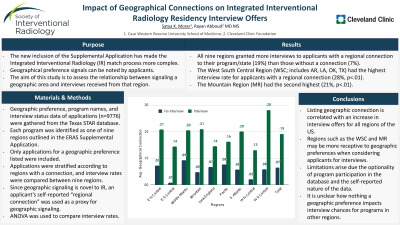
Results: All nine regions granted more interviews to applicants with a regional connection to their program/state (19%) than those without a connection (7%). The West South Central Region (WSC; includes AR, LA, OK, TX) had the highest interview rate for applicants with a regional connection (28%, p<.01). The Mountain Region (MR) had the second highest (21%, p<.01).
Conclusions: Listing geographic connection is correlated with an increase in interview offers for all regions of the US. Additionally, regions such as the WSC and MR may be more receptive to geographic preferences when considering applicants for interviews. As a result of the optionality of program participation in the database and the self-reported nature of the data, this analysis has its limitations. While the conclusions drawn still demonstrate a relationship between geographic preference, matching, and receiving an interview, it is unclear how nothing a geographic preference impacts interview chances for programs in other regions.