Director, Interventional Radiology Clinical Research University of Alabama at Birmingham, United States
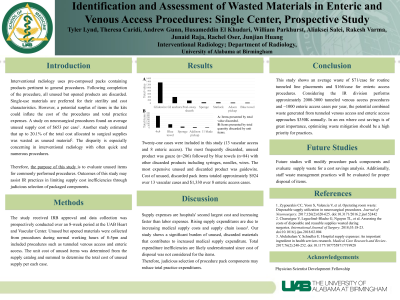
Purpose: Waste in healthcare is ubiquitous and those who practice Interventional Radiology are not immune to suboptimal utilization of resources. Our center, like many, utilize “packs” that consist of pre-determined materials that are generally used for certain case types. Items that are unused but opened must still be discarded following the procedure. The purpose of this study was to identify unused materials and quantify the waste generated during routine vascular access and enteric access procedures. The objective of this study was to describe and quantify unused items and analyze the cost of unused and discarded items in routine tunneled venous access and enteric access procedures.
Methods/Materials: This was a prospective, single center, observational study. IRB approval was obtained and data collection was conducted over a 4 week period. Unused but opened materials were collected from tunneled venous access procedures performed on weekdays, 8am to 5pm. Each individual component was hand sifted and counted immediately following the procedure by a single research fellow, as such not all venous access and enteric access procedures performed during this time frame could be included. The unit cost of unused items was determined from the supply catalog and summed to determine the total cost of unused supply per each case.
Results: Thirteen vascular cases and eight enteric access cases were included in this study. The most frequently discarded, unused product was gauze (n=286) followed by blue towels (n=84). Cost of unused, discarded pack items totaled approximately $924 over 13 vascular cases and $1330 over 8 enteric access cases.
Conclusions: This study shows that there is an average waste of $71/case for routine tunneled line placements and $166/case for enteric access procedures. Considering the IR division performs approximately 2000-3000 tunneled venous access procedures and ~1000 enteric access cases per year, the potential combined waste generated from tunneled venous access and enteric access approaches $350K annually. In an era where cost savings is of great importance, optimizing waste mitigation should be a high priority for practices.