Founder Gilk Radiology Consultants Overland Park, Kansas, United States
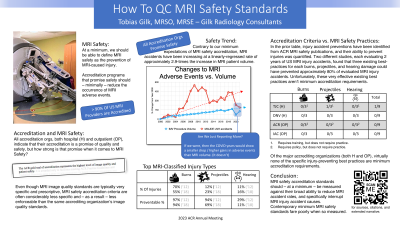
Purpose: Accreditation standards promise assurances of both quality and safety. This study evaluates the degree to which MRI accreditation standards (or general radiology accreditation standards applied to MRI) have required practices which would prevent the most commonly reported forms of MRI accident and injury.
Methods/Materials: Using MedWatch data on MRI-classified adverse events with causation narratives, factors are tested against MRI safety best practice guidance from the ACR 2020 Manual on MRI Safety for the top-3 injury accident types (burns, projectiles, and hearing damage). Narratives are compared against best practices to identify a probability of adverse event prevention. Adverse event-preventing best practices are then compared against minimum printed accreditation criteria from ACR, TJC, DNV, and IAC.
Results: Identified best practices for the prevention of burn and projectile injury accidents are very effective in the prevention of injury accidents. Best practices for the prevention of hearing damage are less effective (recommendations provided for increasing the effectiveness of of prevention of hearing damage to be provided).
When the best practice preventions for these top-3 MRI injury types are compared against contemporary MRI / radiology accreditation standards, it is found that all of the existing major accreditation standards substantially fail to require specific preventions for the most frequently occurring MRI injury types.
Conclusions: Minimum standards could substantially reduce preventable MRI injuries *if* they included these best practices. All accreditation organizations should review the causal pathways of MRI accidents that occur and periodically test the events in those causal pathways against their minimum MRI accreditation criteria. Reviews such as the one conducted in this analysis should reveal 'low-hanging fruit' of standard changes that could have outsized positive impacts on improving MRI safety.