Medical Student University of Nebraska Medical Center Omaha, Nebraska, United States
Purpose: The purpose of this study is to determine if higher fluoroscopic pulse rates increase detection of aspiration in the pediatric patient population.
Methods/Materials: We conducted a large-scale, retrospective study that compared the aspiration rate between the 3 and 7.5 p/s settings. Deglutition studies performed at Children's Hospital and Medical Center in Omaha Nebraska during a two year period were examined. 580 studies meet inclusion criteria. Sample population comprised of 42% females and 58% males, and an age range between 7 days to 18.6 years.
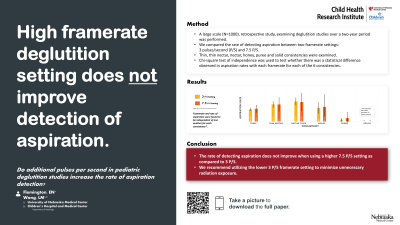
Results: We found that aspiration rate was not significantly different between the 3 and 7.5 p/s settings when the type of swallowed consistency (thins, thin nectar, thick nectar, honey, and puree) was controlled for X2 (1, N = 530) = .0874, p = .7675; X2 (1, N = 165) = .001, p = .9744; X2 (1, N = 92) = 0.0164, p = .8980; X2 (1, N = 42) = .0198, p = .8882; X2 (1, N = 111) = 1.0584, p = .3036.
Conclusions: Our data suggests that the higher 7.5 p/s setting does not increase aspiration detection, so we recommend utilizing the lower 3 p/s setting for future pediatric deglutition studies to minimize patients’ exposure to unnecessary radiation.