Professor of Radiology Rutgers New Jersey Medical School Newark, New Jersey, United States
Purpose: Women and racial minorities are underrepresented in radiology. As radiology programs seek to increase diversity of trainees and competitiveness of the application process intensifies, reliance on certain criteria may affect selection of diverse candidates. Historically, the United States Medical Licensing Examination (USMLE) Step 1 and Step 2 Clinical Knowledge (CK) scores have been used to evaluate applicants. With conversion of reporting of USMLE Step 1 scores to pass/fail, programs may rely more on numerical USMLE Step 2 CK scores and employ cutoff scores to screen the burgeoning applicant pool. The purpose of this study is to assess the effects of Step 2 CK scores on selection of female and underrepresented minority (URM) candidates.
Methods/Materials: We reviewed applications from United States senior allopathic medical students to a radiology residency program from three successive National Residency Matching Program match cycles (2021, 2022 and 2023). Step 2 CK scores had to be reported on the applications for subjects to be included. Self-identification was used to classify subjects as male or female and as URM or non-URM. Step 2 CK scores were compared between males and females, and URMs and non-URMs. We examined the extent of disparate effects of screening using cutoff values for Step 2 CK scores.
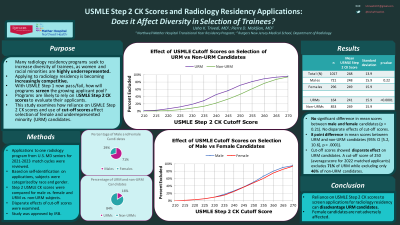
Results: 1017 subjects fulfilled entry criteria. There were 721 males and 296 females, and 164 URM and 853 non-URM. Mean + standard deviation USMLE Step 2 CK scores were: males = 248 + 15.9, females = 249 + 15.9, URM = 242 + 15.9 and non-URM = 250 + 15.9. For males versus females, there was no significant difference in the mean score (p = 0.21) and no disparate effects of cutoff scores. There was a significant difference between the mean score of URM versus non-URM candidates of 8 points (95% confidence interval 5.2 - 10.6, p < .001). Use of cutoffs showed a disparate effect on URM candidates with a cutoff score of 250 (average score for 2022 matched applicants) excluding 71% of URM candidates while excluding only 46% of non-URMs.
Conclusions: Reliance on USMLE Step 2 CK scores to screen applications for radiology residency can disadvantage URM candidates. Females are not adversely affected.