Medical Student Weill Cornell Medicine New York City, New York, United States
Purpose: The ACR Thyroid Imaging Reporting & Data System (TI-RADS) was created to help risk stratify thyroid nodules seen on ultrasound for chance of malignancy to help guide downstream management. While introducing a level of standardization, some of the main drawbacks that persist are the inter-observer discrepancies and the dependence on the operator skill level. To address these limitations, this study aims to develop a deep learning model to help risk stratify thyroid nodules.
Methods/Materials: The dataset includes 480 thyroid ultrasound images (DOI: 10.1117/12.2073532). Each ultrasound image was assigned a TI-RADS score by a radiologist. The dataset was divided into two groups: low-risk (TI-RADS score of 1 to 4a) and high-risk (TI-RADS score of 4b to 5) . The final dataset included 192 high-risk and 233 low-risk thyroid ultrasounds.
Two deep learning models were studied: a convolutional neural network (CNN) and a vision transformer (ViT). The models were trained using the Adam optimizer over the binary cross-entropy loss function. The models were evaluated using 5-fold cross validation.
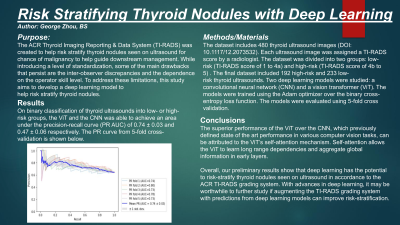
Results: On binary classification of thyroid ultrasounds into low- or high-risk groups, the ViT and the CNN was able to achieve an area under the precision-recall curve (PR AUC) of 0.74 ± 0.03 and 0.47 ± 0.06 respectively.
Conclusions: The superior performance of the ViT over the CNN, which previously defined state of the art performance in various computer vision tasks, can be attributed to the ViT’s self-attention mechanism. Self-attention allows the ViT to learn long range dependencies and aggregate global information in early layers.
Overall, our preliminary results show that deep learning has the potential to risk-stratify thyroid nodules seen on ultrasound in accordance to the ACR TI-RADS grading system. With advances in deep learning, it may be worthwhile to further study if augmenting the TI-RADS grading system with predictions from deep learning models can improve risk-stratification.