Chief Resident Radiology Mather Hospital, United States
Purpose: Many institutions grant Microsoft Teams accounts and at our institution, Teams has joined email as a button option in PowerScribe to convey findings. Teams also has call and chat functionality. Despite the wide adoption of Teams for real-time remote meetings, clinicians are reluctant to adopt Teams for communication with Radiology, and instead rely on telephones and pagers. This study explored the institutional hesitancy regarding communication via Teams and the inefficiency of telephone and pager communication.
Methods/Materials: Surveys were distributed to Radiology residents and referrers at a community hospital via e-mail using Microsoft Forms. Surveys were conducted non-anonymously to facilitate potential further discussion with other departments.
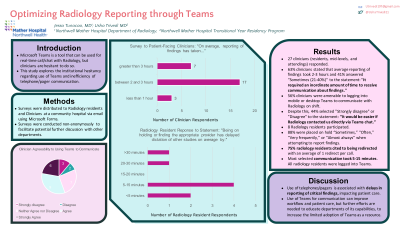
Results: 27 clinicians (residents, mid-levels, and attendings) responded. 63% stated that average reporting of findings took 2-3 hours and 41% answered “Sometimes (21-40%)" to the statement: "It required an inordinate amount of time to receive communication about findings." 56% were amenable to logging into mobile or desktop Teams to communicate with Radiology on shift. Despite this, 44% selected "Strongly disagree" or "Disagree" to the statement: “It would be easier if Radiology contacted us directly via Teams chat.” Respondents elaborated that chats might be missed on busy shifts. It is unclear what percentage were aware of the call feature. Others stated they felt inundated with messages from Cureatr, WhatsApp, and overhead announcements. 8 Radiology residents participated. 88% were placed on hold “Sometimes,” “Often,” “Very frequently,” or “Almost always” when attempting to report findings. 75% cited to being redirected with an average of 1 redirect per call. Most stated that communication required 5-15 minutes. All radiology residents were logged into Teams.
Conclusions: Current use of telephone and pagers is associated with delays in reporting of critical findings, impacting patient care. Use of Teams for communication can improve workflow and patient care, but further efforts are needed to educate departments of its broad capabilities to increase the limited adoption of Teams as a resource.